

9 min read
Hydrostatic vs. Pneumatic Pressure Testing: When Nitrogen Is the Better Test Medium
 N2 Solutions
:
Oct 29, 2026, 10:41:57 AM
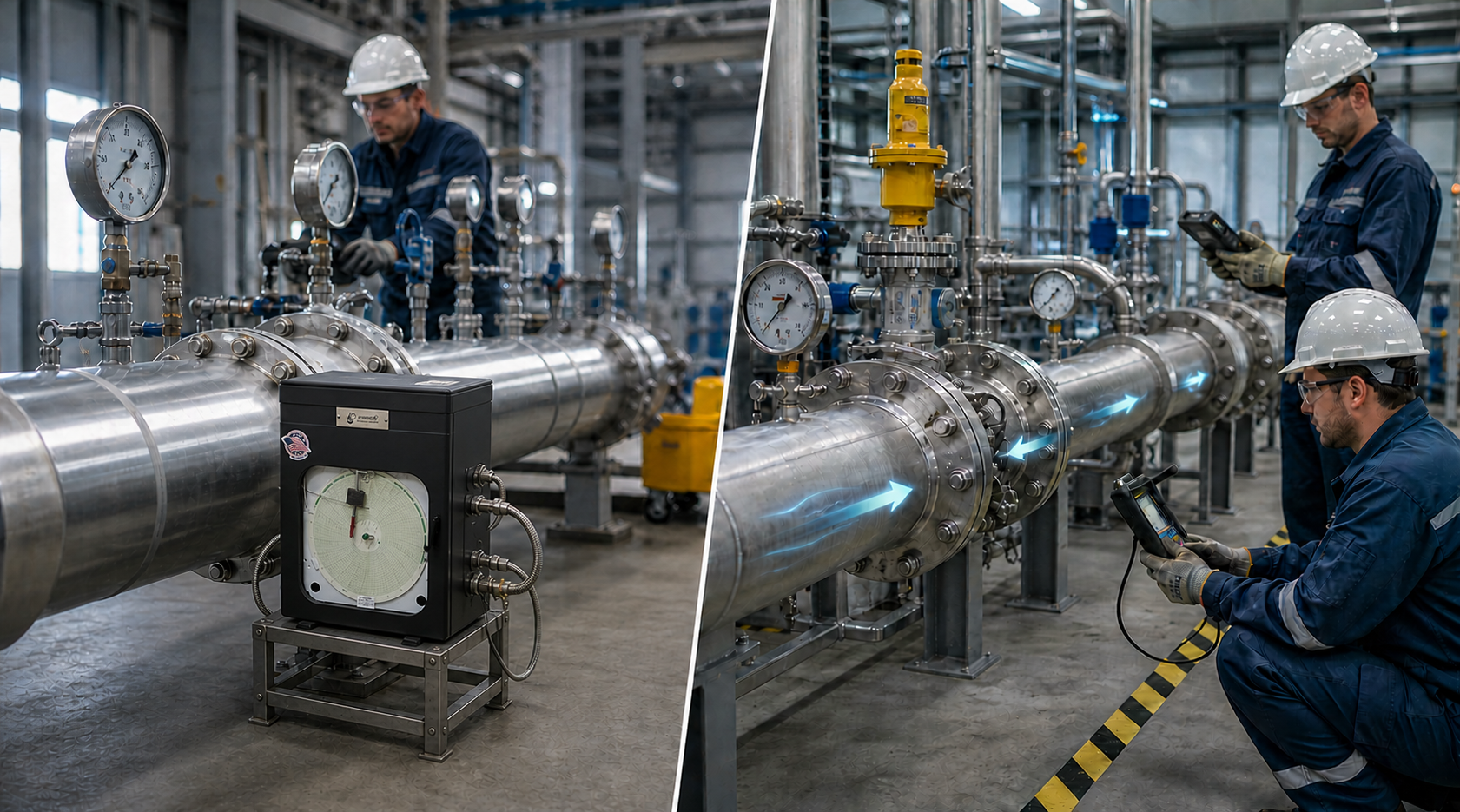
Every new or repaired piping system has to prove it can hold pressure before it goes into service. For most systems, that proof comes from a hydrostatic test. Water is the default test medium for a simple reason: it barely compresses. This means that if something fails during the test, very little energy is released.
Water is not always the right fit, though. Some systems cannot tolerate moisture. Some pipe supports were never designed to carry the weight of a line full of water. And once the test is over, the water has to go somewhere. Dewatering the system, drying it to spec, and handling test water that may need sampling, treatment, or a discharge permit before release can take longer and cost more than the test itself. In those cases, a pneumatic test with nitrogen is often the better choice.
This article compares hydrostatic testing and pneumatic testing with nitrogen, explains where nitrogen makes the most sense, and covers how pneumatic tests are run safely.
What Is the Difference Between Hydrostatic and Pneumatic Pressure Testing?
A hydrostatic test fills a system with water and pressurizes it above its design pressure to confirm strength and identify leaks. A pneumatic test does the same job as a gas. Nitrogen or compressed air are the most common test gases. Helium is usually added to nitrogen as a tracer when the goal is finding very small leaks. The biggest difference between the two methods comes down to compressibility.
Water is nearly incompressible. If a hydrostatic test fails, pressure drops almost instantly, and little energy escapes. Gas behaves differently. Compressed nitrogen stores energy much like a compressed spring, and a failure releases that energy all at once. That is why pneumatic tests run at lower test pressures and under tighter controls.
ASME B31.3, the code for process piping, reflects that difference. A hydrostatic test must be performed at no less than 1.5 times the design pressure, adjusted for temperature (para. 345.4.2). A pneumatic test must be performed at no less than 1.1 times the design pressure. It cannot exceed 1.33 times the design pressure or the pressure that would stress the pipe beyond 90% of its yield strength at the test temperature, whichever is lower (para. 345.5.4). B31.3 also requires owner approval before a pneumatic test is used.
Hydrostatic vs. Pneumatic Testing at a Glance
|
Factor |
Hydrostatic Testing |
Pneumatic Testing |
|
Test medium |
Water |
Nitrogen or compressed air. Nitrogen/helium blends are used for leak detection |
|
B31.3 test pressure |
At least 1.5x design pressure |
At least 1.1x design pressure, capped at 1.33x |
|
Stored energy |
Low |
High, which requires a planned, stepped procedure |
|
After the test |
De-water, dry, and dispose of the test water |
Vent the gas. With nitrogen the system stays dry |
|
Water supply and disposal |
Needs a clean water source. Discharge may need sampling, treatment, or a permit |
None |
|
Added weight on supports |
Significant. Roughly 180 lb per foot on a 24-inch line |
Minimal |
|
Cold weather |
Water can freeze in the system |
No freeze risk |
|
Common applications |
Long transmission pipeline segments and large-volume strength tests |
LNG and cryogenic systems, dry-service lines, instrument lines, and smaller process systems |
When Is Nitrogen the Better Test Medium?
Nitrogen is the better test medium when water damages or contaminates the system or slows the project down. B31.3 permits pneumatic testing when a system cannot be safely filled with water or when traces of water cannot be tolerated once the system is in service. In the field, that covers several common situations.
LNG and Cryogenic Systems
LNG facilities operate near -260°F. Any moisture left behind after a hydrostatic test can freeze during cooldown, blocking small-bore lines and putting instruments and valves at risk. Drying a system to cryogenic standards after a hydrostatic test adds time to the commissioning process. Testing with nitrogen keeps moisture out of the system from the start, so the next step can begin sooner. For more on how nitrogen supports LNG operations, see Nitrogen’s Role in LNG Facilities.
Systems That Must Stay Dry
Some systems are damaged by water even in small amounts. In natural gas lines, leftover water can combine with gas under pressure to form hydrates, ice-like solids that restrict flow and can plug a line. If the gas carries CO2 or H2S, that same water speeds up internal corrosion.
Instrument and control tubing have a small bore, so a little trapped water can plug it, freeze in cold weather, or corrode the instruments it feeds. Gas dehydration units that use molecular sieve beds are another example, since liquid water can damage the sieve material. Testing with nitrogen keeps water out of these systems entirely and removes the drying step that follows a hydrostatic test.
Supports Not Designed for Water Weight
Gas lines, flare headers, and piping overhead racks are often designed to carry gas, not water. Water weight adds up quickly. A 24-inch line full of water weighs roughly 180 pounds more per foot than the same line full of gas. A 36-inch line adds more than 400 pounds per foot. When supports cannot handle that load, a hydrostatic test may require temporary shoring or may not be practical.
Water Supply, Disposal, and Weather
A hydrostatic test needs a clean water source and a plan for what to do with the water afterward. Test water can’t just be dumped since it picks up traces of product in lines that have been in service. Discharges of hydrostatic test water are regulated under the Clean Water Act’s NPDES permit program, often through state general permits. In practice, that means the water usually has to be sampled, and sometimes treated or hauled off, before it can be released. Cold weather adds to the risk of freezing inside the system.
A nitrogen test avoids those steps. Nitrogen is non-toxic and already makes up about 78% of the air we breathe, so test gas from a clean system can generally be vented to atmosphere. Nitrogen displaces oxygen, so it is vented away from workers and out of confined or low-lying spaces. If the system has held hydrocarbons, the vented gas can carry residual product and is handled under the site’s emissions and venting procedures.
For smaller systems, nitrogen testing is often faster and more economical than hydrostatic testing because there is no extensive drying afterward.
Why Use Nitrogen Instead of Compressed Air for Pressure Testing?
Nitrogen is inert and dry. It will not react with residual hydrocarbons, and it does not introduce moisture or compressor oil into the system the way compressed air can. On most jobs, the air comes from one of two places: plant air, the compressed air system already running at the facility, or portable compressors. Unless it is dried and filtered, compressed air carries water vapor and, from some compressors, traces of lubrication oil.
In systems that have already seen product, nitrogen’s inert property is the deciding factor. Air contains oxygen. In a line that still holds traces of hydrocarbons, pressurizing with air can create a flammable mixture. Nitrogen removes that risk.
Systems headed for dry or cryogenic service need a test gas that won't leave moisture behind. Nitrogen supplied from liquid is extremely dry, so the system is ready for the next step as soon as the test is over. Compressed air has to be dried and filtered to reach the same condition.
Nitrogen can also be blended with helium for leak testing. Helium atoms are small enough to escape through the tiniest leak paths. Technicians find those leaks with a helium mass spectrometer leak detector, an instrument built to pick up trace amounts of helium. With the system under pressure, they scan joints and connections with a sniffer probe, and the detector flags helium escaping from leaks too small to find with a soap-bubble test. ASME Section V, Article 10, covers helium mass spectrometer leak testing methods. That level of sensitivity makes nitrogen/helium testing useful during commissioning afterand repairs, when small leaks need to be found before a system goes live.
When Is Hydrostatic Testing Still the Right Choice?
Hydrostatic testing remains the standard for long, high-pressure transmission segments and large-volume strength tests. On those systems, the stored energy of a gas test can be too high to manage safely.
Federal regulations also limit gas testing on pipelines. Under 49 CFR 192.503(c), a strength test using air or an inert gas such as nitrogen can only stress the pipe to a set percentage of its specified minimum yield strength (SMYS). That limit depends on the pipelines’ class location, which is based on how many buildings are near the line.
|
Class Location |
Maximum Hoop Stress for an Air or Inert Gas Test |
|
Class 1 |
80% of SMYS |
|
Class 2 |
75% of SMYS |
|
Class 3 |
50% of SMYS |
|
Class 4 |
40% of SMYS |
Above those limits, gas pipelines require hydrostatic testing. Owner specifications may also call for hydrostatic testing regardless of class location. The right test medium depends on how the system is designed and where it is headed once it goes into service.
Is Pneumatic Pressure Testing Dangerous?
A pneumatic test carries more risk than a hydrostatic test because compressed gas stores far more energy than water at the same pressure. That risk is managed through planning and procedure, and codes spell out many of the controls.
Under ASME B31.3, a pneumatic test starts with a preliminary check at the lesser of one-half the test pressure or 25 psi. Pressure is then raised gradually in steps, holding at each step long enough for piping strains to equalize. A pressure relief device must be in place, set no higher than the test pressure plus the lesser of 50 psi or 10% of the test pressure. Once at test pressure, the system is held for at least 10 minutes before it is examined for leaks.
Beyond the code minimums, a safe test depends on the team running it. Industry guidance such as ASME PCC-2 provides methods for calculating stored energy and setting safe distances so that personnel stay clear of the system while it is under pressure. Equipment should be inspected and function-tested before the job begins, and everyone on site should understand the test plan and their role in it.
N2 Solutions builds planning into each job before a crew mobilizes. On the ethane cracker startup described below, work began with a pre-job planning to meet to document the customer’s expectations for personnel and equipment. Every assigned employee was checked for current training and operator qualifications (OQs) before arriving on site. Equipment was inspected and function tested ahead of time, and the crew completed a job safety analysis on location before pumping began.
How N2 Solutions Supports Nitrogen Testing
N2 Solutions provides nitrogen testing services aligned with ASME B31.3 for process piping and ASME B31.8 for transmission pipelines. Services include:
- Nitrogen pressure testing to verify system integrity without the drying requirements of hydrostatic testing.
- Nitrogen/helium leak testing during commissioning and post-repair validation, without introducing moisture into the system.
- Post-installation instrument testing to confirm pressure sensors, flow meters, and control valves perform as designed.
- Tightness testing for LNG facilities, using high-sensitivity helium testing to verify cryogenic containment before commissioning, in line with ASME Section V, ASME Section VIII, and NFPA 59A.
Testing is backed by a fleet of nitrogen pump trucks ranging from 250 to 16,500 standard cubic feet per minute (scfm) and on-site storage trailers holding up to 24,000 gallons of liquid nitrogen. As an independent nitrogen company, N2 Solutions sources from multiple suppliers across the U.S. rather than relying on a single plant. That keeps supply steady when demand strikes during a test or startup.
Pneumatic testing is also one step in a larger commissioning scope, and N2 Solutions handles the steps around it. The same crew that pressure tests a system can purge, dry, and it. Operators work with one vendor instead of passing the system from contractor to contractor before startup, which means fewer scheduling gaps and a single set of records for the whole job. Across midstream, downstream, upstream, and LNG work, N2 Solutions has delivered more than 1.7 billion standard cubic feet of nitrogen and provides 24/7 emergency response.
Project Spotlight: Nitrogen Supply for a Louisiana Ethane Cracker Startup
Pressure testing, purging, and drying all happen during commissioning, and every one of them depends on a steady nitrogen supply. One N2 Solutions project in Louisiana shows what looks like at scale.
LACC, LLC, a joint venture between Lotte Chemical USA and Westlake Corporation, needed nitrogen to commission and start up a new ethane cracker. The plant’s existing nitrogen line was built mainly to supply instrumentation, and the new units needed more gas than it could deliver. N2 Solutions brought in liquid nitrogen by truck and converted it to gas on site.
Over three weeks, the team pumped about 75 million standard cubic feet (MMscf) of nitrogen. That works out to roughly 150 truckloads and 805,000 gallons of liquid. Demand swung with the startup schedule, and on some days up to 25 loads had to be sourced and delivered on short notice. At the peak, the team handled 57 loads in four consecutive days.
Eighteen N2 Solutions personnel worked the job, running pumping units across the plant while an on-site logistics coordinator scheduled each delivery and offload.
When one supplier could not cover a 19-load request, N2 Solutions filled it by pulling liquid from several suppliers. Because the company isn’t tied to a single source, the startup stayed supplied.
“N2 Solutions provide us with the safety, flexibility and dependability necessary for our initial plant startups and as well as for periodic plant turnarounds. We have a strong relationship with N2 Solutions, and look forward to their continued support.”
Mark Peters, Site Director, Lotte Chemical USA. Read the full LACC case study.
Frequently Asked Questions
What is pneumatic pressure testing?
Pneumatic pressure testing uses compressed gas, usually nitrogen or air, to pressurize a system and verify its strength and leak tightness. It is used when water cannot be introduced into a system or when traces of water cannot be tolerated in service. Because gas stores more energy than water, pneumatic tests follow stepped, tightly controlled procedures.
Why is nitrogen used for pressure testing?
Nitrogen is inert and dry. It does not support combustion, which makes it safer than air in systems that may hold residual hydrocarbons. It also leaves no moisture behind, so there is no need for a drying step after the test. That makes nitrogen well suited to LNG, cryogenic, and dry-service systems.
What pressure is a pneumatic test performed at?
Under ASME B31.3, a pneumatic test is performed at no less than 1.1 times the design pressure. It cannot exceed the lesser of 1.33 times the design pressure or the pressure that would stress the pipe beyond 90% of its yield strength. A hydrostatic test under B31.3 is performed at no less than 1.5 times the design pressure.
How long is a pneumatic test held?
ASME B31.3 requires the test pressure to be held for at least 10 minutes before the system is examined for leaks. For gas pipelines regulated under 49 CFR Part 192, strength tests on steel lines operating at 30% of SMYS or more must be held for at least 8 hours. Lines operating below 30% of SMYS at 100 psi or more must be held for at least 1 hour.
Can nitrogen be used for leak testing?
Yes. Nitrogen is commonly used for leak testing, often blended with helium. Helium can escape through very small leak paths and can be traced with sensitive detectors, which helps crews find leaks during commissioning or after repairs without adding moisture to the system.
What is a tightness test?
A tightness test verifies that a system is sealed before it goes into service. For LNG facilities, tightness testing often uses high-sensitivity helium testing to confirm cryogenic containment integrity before commissioning.
Choosing the Right Test Medium
On LNG and cryogenic systems, dry-service lines, rack-supported piping, and smaller process systems, nitrogen often gets the job done faster and leaves the system ready for startup.
Planning a commissioning, tie-in, or pre-startup test? Talk to the N2 Solutions team about whether nitrogen is the right test medium for your system, or explore our nitrogen testing services.