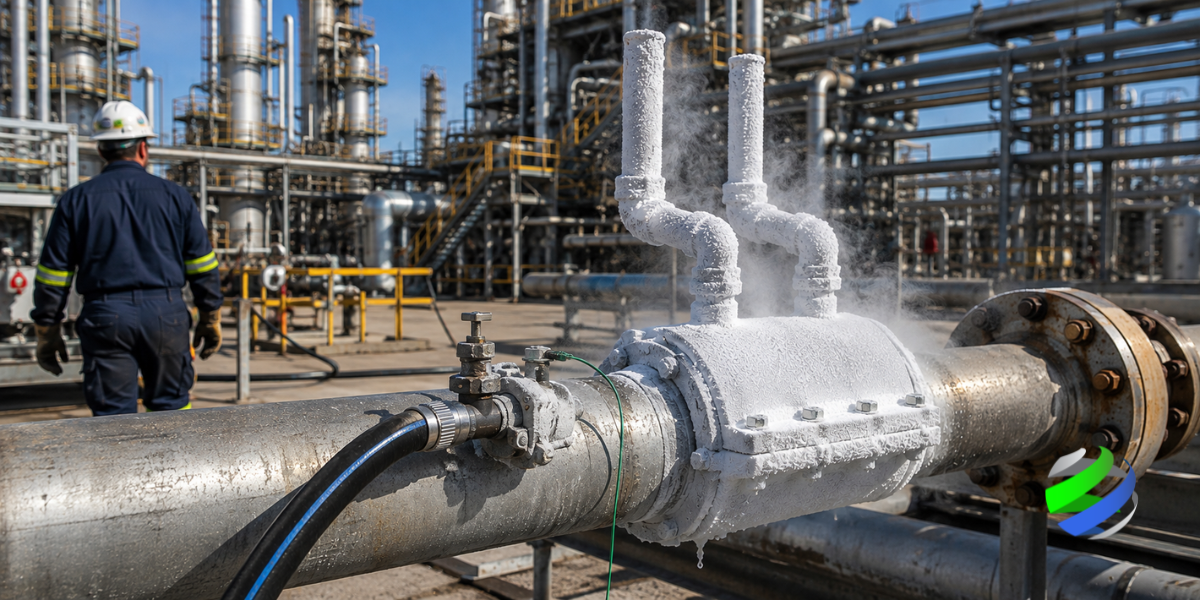
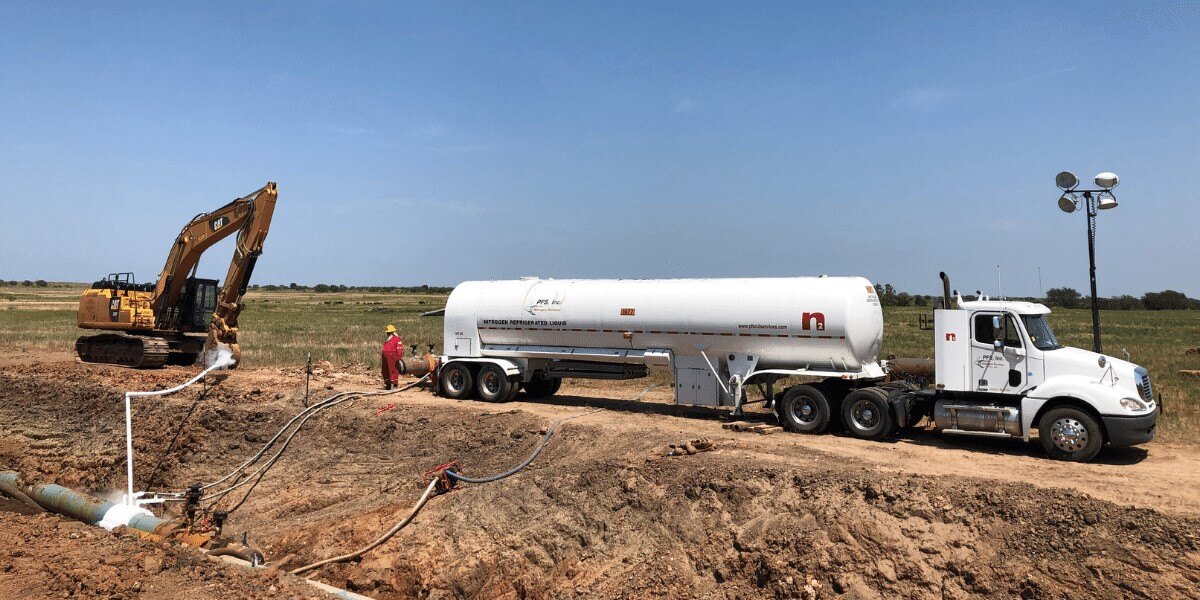
Pipe freezing helps energy, industrial, and utility teams isolate a section of piping without draining the full system, reducing downtime during maintenance.
This blog explores the many uses of pipe freezing services, showcasing their adaptability and why they are an essential solution for industries aiming to reduce downtime and maximize performance.
- What is Pipe Freezing and How Does It Work?
- What Are Pipe Freezing Services Used For?
- Which Industries Benefit from Pipe Freezing Services?
- FAQ
- How N2 Solutions Can Help with Pipe Freezing Applications
What is Pipe Freezing and How Does It Work?
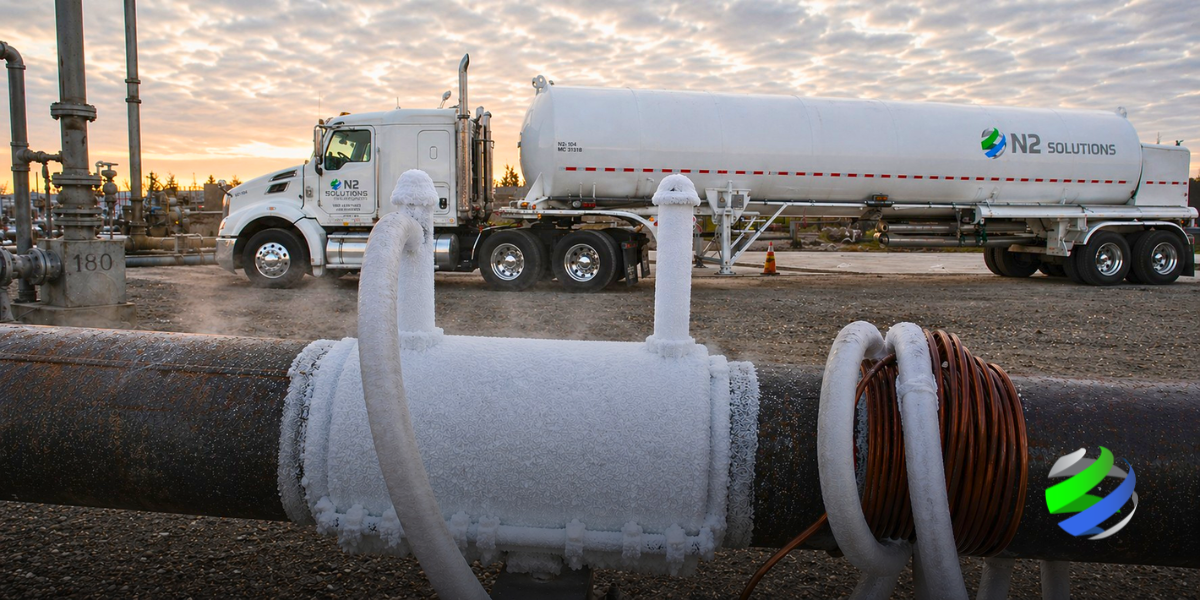
Pipe freezing is a controlled method that uses liquid nitrogen to create temporary ice blockages inside a pipe or system, allowing safe isolation without draining or shutting down the entire operation. In this process, a freeze plug forms around a targeted section of pipe, creating a solid, dependable barrier. That plug holds pressure and flow so teams can perform maintenance, mechanical repairs, or leak detection on the isolated section while the rest of the system remains in service.
What Are Pipe Freezing Services Used For?
Pipe freezing services can be applied across a wide range of operating environments to support maintenance, troubleshooting, and system isolation. Common uses include:
- Leak detection, location, and isolation to identify and contain problem areas more efficiently
- Mechanical isolation for repairs when work must be completed on a specific section of piping
- Fluid cool downs for processes that require controlled temperature reduction
- Pneumatic cool downs in systems where temperature management supports performance or maintenance
- Solid cool downs for applications that require precise cooling of materials or components
Which Industries Benefit from Pipe Freeze Applications?
The versatility of pipe freezing services extends across multiple markets, including:
Pipelines
In the midstream oil and gas sector, pipe freezing plays a critical role in mainline valve replacements, hydrostatic test isolations, and pipeline diversions or tie-ins. By forming a controlled freeze plug at the required location, operators can isolate the affected section to complete this work, limit field exposure along the right-of-way, and avoid a full pipeline shutdown.
Refineries
Within refineries, pipe freezing can be implemented on several critical applications, including firewater main repairs, cooling water systems, and hydrocarbon isolation. By forming a temporary freeze plug, refinery teams can isolate these lines to replace valves, repair piping, or modify tie-ins. This approach helps maintain process safety, protects equipment, and limits the scope and duration of outages during planned work or emergent repairs.
Petrochemical Plants
Because petrochemical plants handle volatile, high‑purity streams, pipe freezing in these units is designed to prevent contamination, protect product quality, and safely manage elevated pressures. Typical applications include polymerization loop maintenance, ammonia and chemical feed lines, and flare header tie-ins during modifications or repair work.
Municipalities
City water systems and sewage networks can use pipe freezing to isolate specific segments of piping for repair or inspection while maintaining service to the broader community. This approach helps municipalities complete critical work with less disruption to residents and businesses. It also gives utility teams a controlled way to address infrastructure issues without taking larger sections of the system out of service.
Hospitals
In medical facilities, maintaining operational HVAC and plumbing systems is crucial. Freeze plugs minimize disruptions, ensuring patient care is uninterrupted while work is performed on chilled water, heating water, or domestic water lines. This allows hospitals to complete valve replacements, line repairs, and tie-ins in sensitive areas without taking critical spaces or entire buildings out of service.
HVAC Systems
Chillers, cooling systems, cooling towers, chilled water loops, valve retrofits, and other HVAC components in large facilities benefit significantly from pipe freezing techniques. By creating temporary freeze plugs, technicians can isolate specific sections of these systems for upgrades, valve or piping work, or emergency leak control.
Breweries and Paper Mills
Breweries use freeze plugs to isolate fermentation tanks or coolant systems for maintenance, cleaning, and equipment changes without warming product or shutting down adjacent lines. By forming a temporary ice plug in the appropriate header or branch, teams can work on valves, piping, or heat exchangers while protecting temperature-sensitive processes. Similarly, paper mills can apply pipe freezing to manage chemical flows, isolate sections of stock or chemical distribution systems, and prevent production downtime during repairs or tie-ins.
FAQ
How do you confirm a successful pipe freeze?
We employ thermocouples and monitor the frost ring generated by our freeze jackets. Multiple checks and balances are in place to verify that the freeze is stable and effective.
Is pipe freezing risky for the pipe itself?
No, our trained technicians ensure that proper spacing and pressure venting measures are in place to prevent cracking due to ice expansion.
What is the maximum pipe diameter that can be frozen?
We can accommodate pipes up to 72 inches in diameter with our current freeze jacket inventory.
What is the duration of a freeze plug?
As long as you need. Specify your required duration during the scheduling process.
Is pipe freezing safe?
Safety is a priority. We assess various factors like temperature, flow, and location before initiating any freeze to guarantee secure operation.
What geographic areas do you serve?
We primarily service the West Gulf, East Gulf, Southeast, and Northeast United States.
What is the typical temperature range used for a pipe freeze?
We utilize liquid nitrogen at around -320°F, but freeze temperatures are adjusted between -100 to -275°F depending on the product.
Does pipe freezing weaken the pipe?
On the contrary, controlled exposure to cryogenic temperatures essentially "heat treats" the pipe, making it stronger.
What are the prerequisites for a successful pipe freeze?
Several conditions must be met, such as the liquid in the pipe being freezable and static.
When should I consider pipe freezing?
Our technology is versatile enough to be used for various repair or upgrade scenarios without requiring system shutdowns.
Does wall thickness impact pipe freezing?
Wall thickness doesn't impact the freeze. Our technology has shown no discernible damage to pipes of varying thicknesses.
How N2 Solutions Can Help with Pipe Freezing Applications
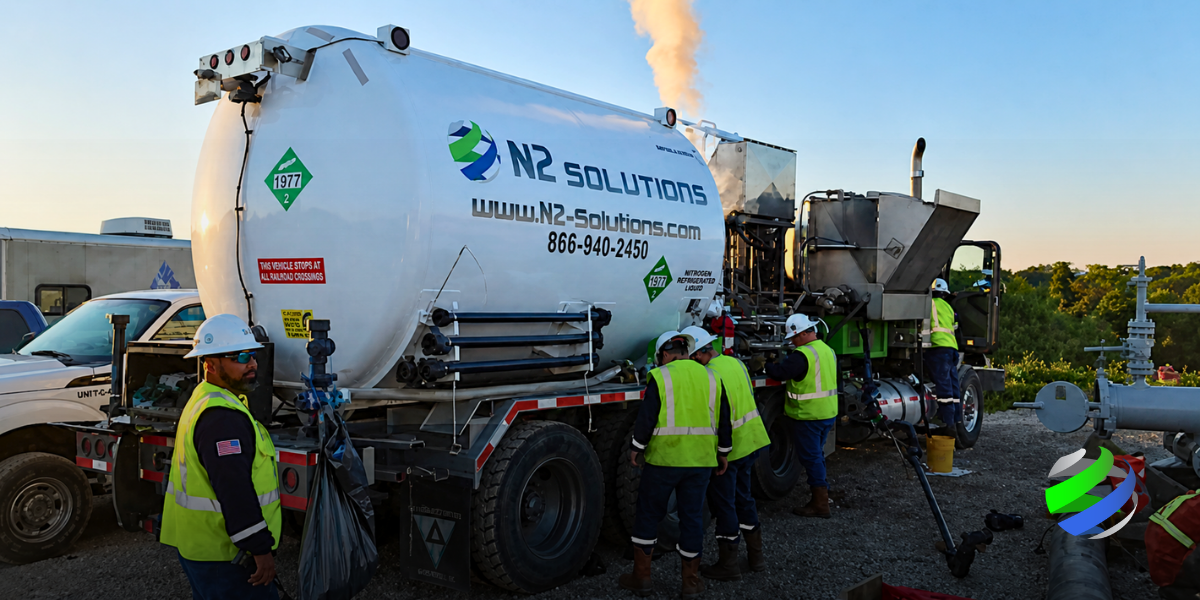
At N2 Solutions, we specialize in pipe freezing and freeze plug services engineered to meet the demands of complex industrial and energy assets. Our team works with customers to identify practical freeze plug applications that enhance safety, protect equipment, and support more efficient project execution. Contact N2 Solutions today to request a quote for your next project.


 N2 Solutions


 N2 Solutions : Nov 18, 2024, 10:11:53 AM