

 N2 Solutions
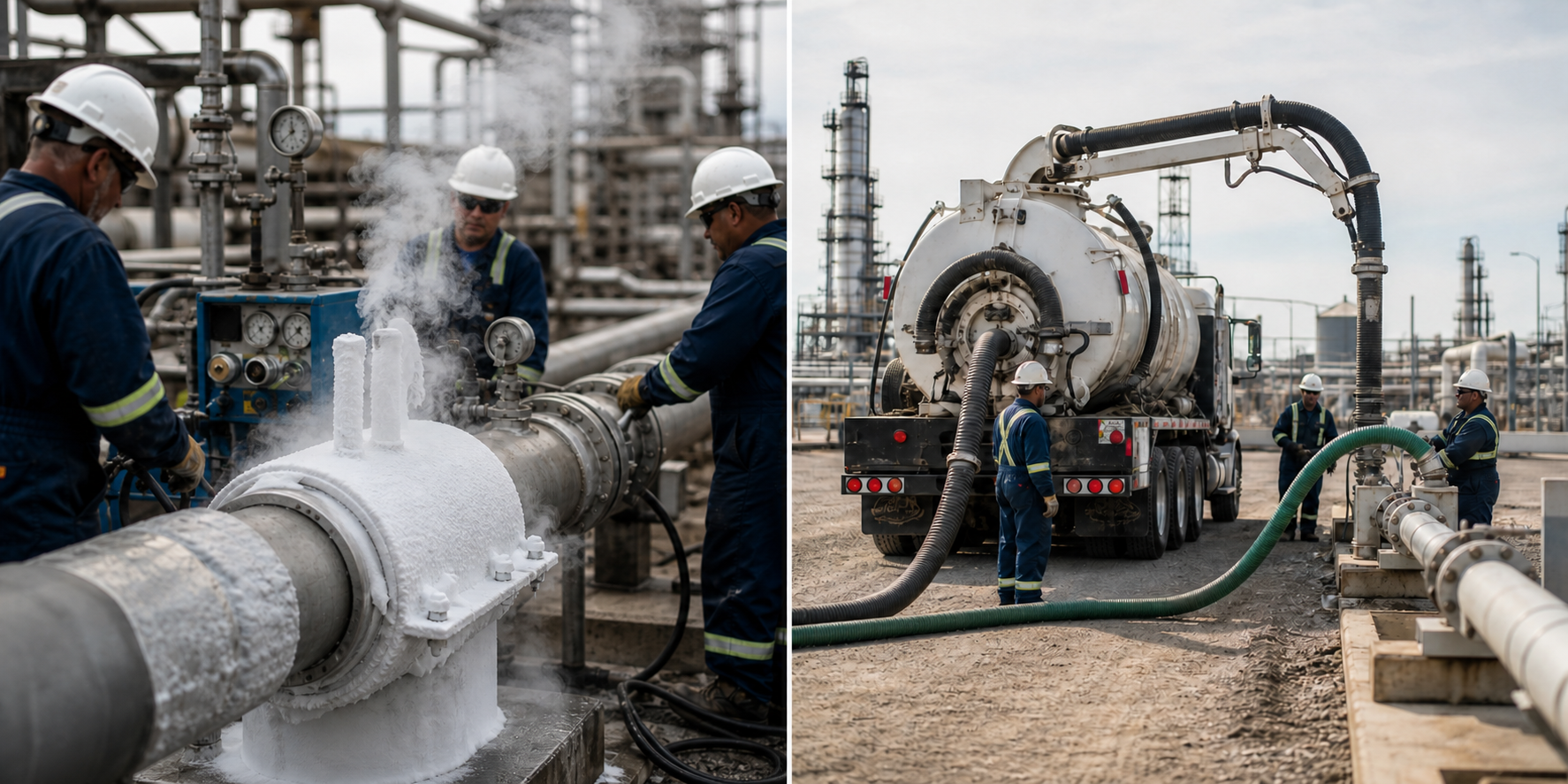
A leak in a product-filled pipeline creates two scopes of work: repairing the defect and preparing the line so that repair can proceed safely. When existing isolation valves are far from the leak, removing the inventory between them can add substantial product handling to a localized repair.
For suitable applications, pipe freezing can be the better choice because it establishes isolation closer to the work and retains inventory outside the repair section. N2 Solutions provides pipe freezing services as part of its nitrogen and pipeline service offering.
The advantage is conditional. The contents must support a qualified freeze isolation, and the pipe and operating conditions must permit it. Product remaining elsewhere in the line does not mean personnel can open a pressurized, product-filled repair section.
Key takeaways for product-filled pipeline repairs
Pipe freezing offers a potential cost advantage by reducing the volume that must be evacuated, rather than eliminating every product-handling task.
- Local isolation can retain inventory that would otherwise need to be transferred from a larger pipeline section.
- Recovery, storage, transport, treatment or disposal, and reinstatement can increase the total evacuation scope.
- The repair section still requires verified isolation, depressurization, and appropriate product removal and atmospheric controls.
- The products must be static and freezable to determine whether freezing can be achieved.
- Freeze formation, monitoring, nitrogen supply, contingency arrangements, and controlled thawing belong in the cost comparison.
Two approaches to preparing a pipeline for leak repair
Product evacuation removes product from a pipeline; pipe freezing creates a temporary freeze plug using liquid nitrogen, which isolates a section of the line without draining the entire system.
Product evacuation between existing isolation points
An evacuation plan establishes isolation boundaries and removes inventory from the work section through an approved recovery or displacement process. Depending on the configuration, existing valves may define a much longer section than the damaged pipe itself.
Evacuation does not automatically make a line safe for intrusive work. Residual liquid, flammable vapor, trapped pressure, and passing valves must be addressed through the operator's isolation and permit-to-work procedures. Where required, nitrogen purging supports preparation of the work section.
Localized freeze isolation
Pipe freezing applies controlled external cooling to form a temporary solid plug in suitable liquid-filled piping. The exact number and location of plugs depend on every potential pressure source.
N2 Solutions' contractor evaluation guidance explains why freeze location, pipe condition, temperature monitoring, and contingency planning require application-specific assessment. The plug provides isolation; it does not repair the defect. The video below explains how the pipe freezing process works.
Why product evacuation can expand repair costs
Evacuation can become expensive when the inventory requiring removal is large relative to the actual repair area.
The pumping quote is only one part of that cost. Your comparison should identify which additional activities the product, recovery destination, and site conditions require.
- Product and water recovery: Transfer equipment, hoses, connections, personnel, and an approved receiving destination.
- Temporary storage: Suitable tanks or other containment where existing facilities cannot accept the inventory.
- Transportation: Movement of recovered product or water when an on-site destination is unavailable.
- Water disposition: Assessment of whether recovered water can be reused, requires treatment, or must be disposed of.
- Return to service: Refilling, verification, and other reinstatement activities required by the repair plan.
How pipe freezing can keep surrounding inventory in place
Freeze isolation can retain product outside the repair envelope by moving the isolation boundary closer to the defect.
Consider a localized repair where the nearest usable isolation points leave a large inventory within the work section. If suitable freeze locations are available nearer the defect, the repair plan may require removal of only the smaller volume within the new boundaries.
The same local-isolation principle appears in N2 Solutions' Reagan County project, where N2 Solutions used freeze isolations to support leak location and repair without dewatering and refilling the entire test section. That was a hydrostatic-test application, a product in the gaseous phase cannot be frozen.
Another example of how pipe freezing is beneficial is N2 Solutions' Superdome cooling-system project, which avoided draining the full system within the facility. These examples demonstrate scope reduction on suitable systems; they do not establish compatibility for a different pipeline product.
Why localized isolation can be the better choice
Pipe freezing can be preferable when the cost and disruption avoided by retaining inventory outweigh the work needed to establish and maintain the freeze.
Less product to move and manage
A smaller isolated volume can reduce recovery, storage, and transfer requirements. It may also reduce product disposition costs where removed inventory cannot be returned to service. The benefit depends on the actual inventory retained and the handling activities avoided.
A more focused outage scope
Local isolation can reduce the section that must be drained and reinstated. However, freezing takes time to establish, maintain, and thaw. Savings depend on the complete sequence, not an assumption that a freeze forms immediately.
A freeze plug blocks flow at its location. Retaining the inventory does not keep through-flow operating across the repair. Continued operation elsewhere depends on the network configuration, alternative flow paths, and the operator's approved plan.
What must be verified before freezing a product-filled line?
A product-filled line is a freeze candidate only after project management reviews and confirms suitable fluid, pipe, pressure, flow, and access conditions.
- Fluid behavior: Confirm composition and whether the contents can form a stable isolation plug. A hydrocarbon or chemical service designation alone does not establish suitability.
- Pipe condition: Assess material, wall thickness, defects, and low-temperature behavior at the proposed freeze location. Do not assume a sound-looking pipe is cryogenically compatible.
- Flow: Establish the required static conditions at the freeze point. Leakage, passing valves, or convection can interfere with formation and maintenance of the plug.
- Pressure sources: Evaluate differential pressure, possible backfeed, trapped liquid expansion, and required relief arrangements.
- Location and access: Confirm clearance, pipe geometry, proximity to the defect, and separation from repair heat or other disturbances.
- Duration and contingency: Provide nitrogen capacity, monitoring, personnel, and a response plan for delays or loss of isolation.
- Cryogenic and atmospheric hazards: Address cold exposure, nitrogen venting, oxygen displacement, ventilation, and appropriate atmospheric monitoring.
The NRC's freeze-plug technical guidance, written for nuclear fluid systems, documents the importance of qualified personnel, reliable monitoring, adequate coolant supply, and contingency procedures. It is relevant background on freeze-isolation hazards, not an approval standard for a hydrocarbon pipeline repair.
Broader pipe freezing applications span multiple industries. That range does not remove the need to qualify your specific product and proposed isolation.
When product evacuation remains necessary
Product evacuation remains appropriate when a freeze cannot be qualified or when the repair requires clearance of a larger section.
Non-freezable contents, unsuitable pipe condition, inaccessible freeze points, or non-static flow can rule out freezing. An active leak may itself prevent the static conditions needed at a proposed location. Emergency leak response must not be delayed while pursuing an unsuitable freeze.
Freezing and evacuation are not always the only possible isolation methods. Your engineering and operations teams must select an arrangement accepted under applicable requirements and site procedures. Neither cost preference nor equipment availability substitutes for that decision.
Compare the complete repair plan, not just the service quote
The better service is the one that delivers an acceptable isolation and repair plan at the lower total project burden.
Compare the same work scope on both sides: engineering, mobilization, isolation, product handling, monitoring, repair access, testing, and reinstatement. For freeze isolation, include the full hold duration and contingency supply. For evacuation, include actual recovery and disposition costs rather than pumping alone.
Your pressure testing plan should follow the applicable repair requirements. A change in isolation method does not automatically determine the test medium or eliminate testing obligations.
For a suitable localized leak repair, pipe freezing can make the project smaller by leaving surrounding inventory in place. That is the operational basis for choosing freezing over broader product evacuation: less unnecessary handling, without reducing the isolation controls needed to perform the repair safely.
Frequently asked questions about freeze isolation
How does N2 Solutions confirm a successful pipe freeze?
We employ thermocouples and monitor the frost ring generated by our freeze jackets. Multiple checks and balances are in place to verify that the freeze is stable and effective.
Is pipe freezing risky for the pipe itself?
No, our trained technicians ensure that proper spacing and pressure venting measures are in place to prevent cracking due to ice expansion.
What is the temperature range for a pipe freeze?
We utilize liquid nitrogen at around -320°F, but freeze temperatures are adjusted between -100 to -275°F depending on the product.
How safe is it to perform a pipe freeze?
Safety is a priority. We assess various factors like temperature, flow, and location before initiating any freeze to guarantee secure operation.

About N2 Solutions
 N2 Solutions strengthens their position as a nitrogen services leader, expanding its locations and product offerings. With pump trucks, nitrogen transports, pig tracking, and pipe freeze technology, N2 delivers cost-effective solutions to energy, industrial, chemical, and pipeline clients. N2 Solutions sets a new standard of excellence in nitrogen solutions for their customers.